In 2025, the Fondation Charles-Bruneau made an ambitious commitment to invest $50 million between 2025 and 2030 to support research and improve paediatric hematology and oncology care in Quebec.
Our commitment
An historic
An historic
commitment
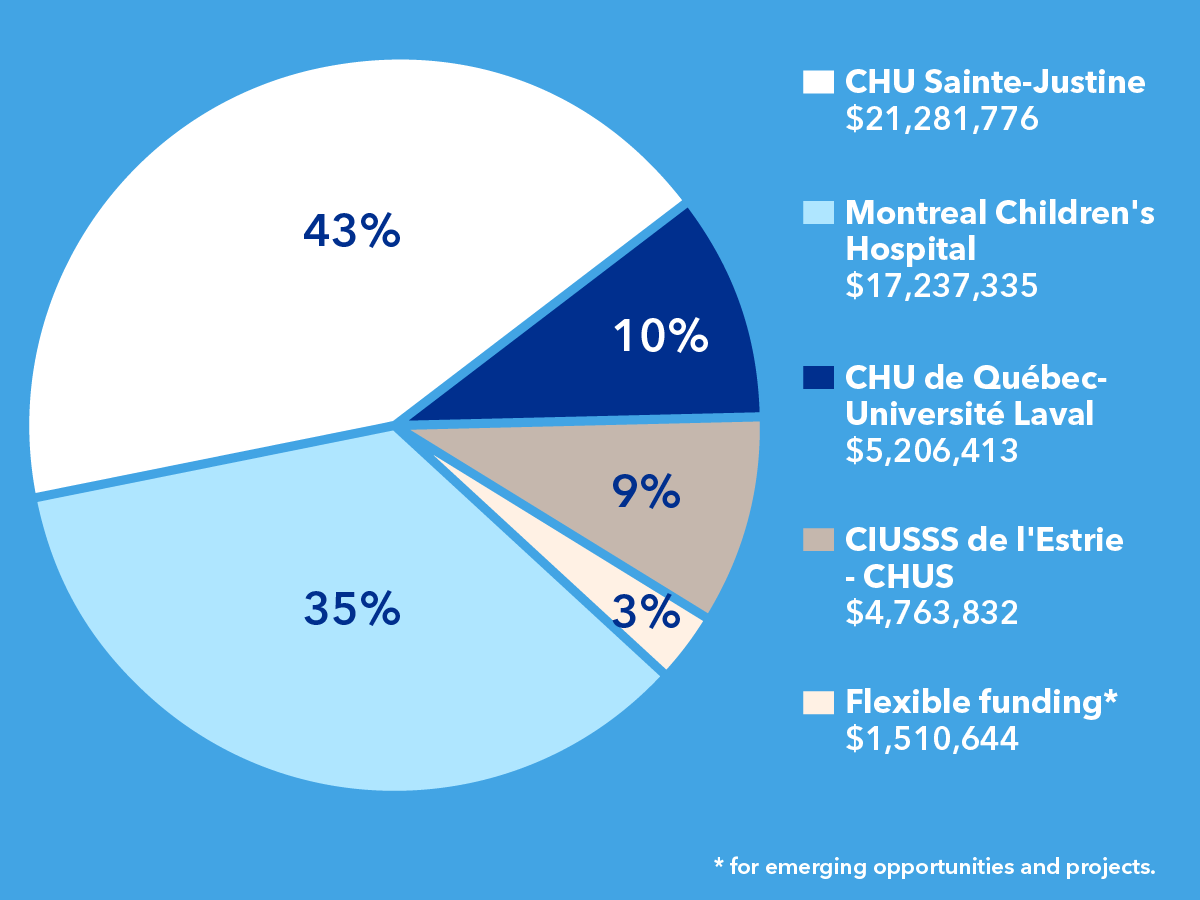
Distribution of the sums pledged
The funds are remitted to research projects submitted by Quebec-based university hospital centres that receive and treat children with cancer. The sums requested for various projects vary, which explains why the amounts per centre are not identical.
- CHU Sainte-Justine: $21,281,776
- Montreal Children’s Hospital: $17,237,335
- CHU de Québec-Université Laval: $5,206,413
- CIUSS de l’Estrie – CHUS: $4,763,832
- Flexible envelope to respond to opportunities or emerging projects: $1,510,644
At a glance
What is financed with this historic commitment
- Offer more timely and complete diagnoses.
- Target recurrent or refractory cancers.
- Prevent cancers linked to genetic predispositions.
- Identify personalized and less invasive treatments.
- Screen for toxic effects associated with therapies.
- Test treatments on living tumours in a laboratory.
- Implement a new clinical care trajectory for medulloblastomas.
- Maintain living tumours after surgery to test how they respond to various medications.
- Identify the most promising molecules based on the unique profile of each patient.
- Improve the quality of life of survivors.
Problems targeted under the pilot project on medulloblastoma:
- Medulloblastomas are the most common brain tumours among children.
- 30 to 40% of children with a medulloblastoma do not survive for more than five years, and those who do may experience long-term side-effects.
- Mobilize the immune system against complex tumours.
- Acquire a more in-depth understanding of the biological mechanisms at work in tumours.
- Identify innovative potential solutions in immunotherapy.
- Offer personalized alternatives to children whose options are limited.
Problem targeted by the multi-omic study on the immune environment of paediatric tumours:
- Certain cancers cannot be cured using standard therapies.
- Integrate the study of proteins to refine diagnoses.
- Pair proteomics with genomic profiling for greater precision.
- Better guide therapeutic decision-making.
- Structure a strong provincial expertise in personalized medicine.
- Secure and optimize treatments administered at home.
- Help families with care management outside of the hospital.
- Strengthen adherence to treatment among young patients and teens.
- Improve prognoses and overall quality of life.
Problems targeted under the support program and oral chemotherapies:
- Long and difficult treatment: acute lymphoblastic leukemia entails multiple hospitalizations and medical appointments along with major disruptions to everyday life.
- Critical adherence: Low adherence to oral treatments increases the risk of recurrence. The adverse effects associated with treatment complicate follow-up (immunosuppression, sleep disorders, weight gain, irritability, sadness).
- Impact on quality of life: In addition to side-effects, oral chemotherapies come with precautions, including isolation at school for about one year.
- Lack of adapted support: Few interventions have been developed specifically to support families with care management at home.
- Prevent vascular complications associated with treatments.
- Understand the develolpment of blood clots (thromboembolism).
- Identify high-risk patients at the outset of the care trajectory.
- Avoid serious complications and improve the comfort of patients.
Problems targeted under the research project on thromboembolism among children with cancer:
- About 10% of children develop a thromboembolism, which increases the risk of death by two to four times and leads to numerous long-term complications, including pulmonary hypertension and problems linked to catheters.
- Prevent after-effects and promote physical health.
- Reduce the long-term impacts through nutrition and physical activity.
- Offer psychosocial support adapted to the family.
- Deploy specific content for teens (VIE-Ado).
Problems targeted under the Programme VIE:
- Taste changes due to treatments, leading to less healthy dietary choices.
- Not enough time to prepare healthy meals.
- Not enough physical activity, in spite of the health benefits Emotional challenge for families, limiting attention to life habits.
“Everything tastes like metal. The child stops eating, and if they don’t eat, their chances of recovery are compromised. The parents give them what they prefer, which is often food high in salt and sugar. This diet then becomes a habit, which can cause the child to develop a weight problem and eventually type 2 diabetes.” – Daniel Sinnett, Professor, Researcher, Centre de recherche du CHU Sainte-Justine
- Support families for the duration of the care trajectory.
- Assess the impact of cancer on parents for improved intervention.
- Train care staff in Charles-Bruneau Units and Centres.
- Facilitate the delicate transition from paediatric to adult care.
Problem targeted under the Quebec platform in psychosocial oncology:
- The negative effects of cancer on the mental health of families (distress)
- Ensuring the future of paediatric hematology and oncology.
- Training emerging scientists to ensure the excellence of care in Quebec.
- Supporting researchers who become vectors for sustainable medical progress.
The two components of the Charles-Bruneau Award Program:
- Charles-Bruneau Emerging Scientist Awards: for master’s level, doctoral or postdoctoral students. Encourages emerging scientists and promotes sustained excellence in paediatric hematology and oncology in Quebec.
- Charles-Bruneau Clinical Excellence Awards: for the advanced specialization of residents, clinical fellows, nurses, pharmacists and other professionals. Strengthening the competencies of care teams and promoting international recognition.
Number of students/award recipients supported through this commitment:
- CHU Sainte-Justine → 2
- CHU de Québec-Université Laval → 6
- Montreal Children’s Hospital → 10
The Fondation Charles-Bruneau selects the programs and projects it finances based on five main priorities
Integrity
Finance research on all phases of cancer among children, from prevention to survival, diagnosis and treatment.

Innovation
Promote innovation by financing emerging initiatives with the idea that the State will go on to institutionalize those that prove effective and legitimate.

Equity
Promote regional equity of access to care and services.

Sharing knowledge
Help share knowledge and train the next generation of researchers in paediatric hematology and oncology.

Collaboration
Support collaboration and consensus-building among various caregivers and stakeholders.